Fibre Laser Running Costs: What Does a Fibre Laser Cost to Run?
Before you commit to a fibre laser, you need to know what it costs to run once the purchase price is paid. The machine itself is the headline figure, but the day-to-day spend on electricity, assist gas, consumables and maintenance is what determines whether the investment works for your workshop long term.
Fibre laser running costs vary depending on machine power, material type, cutting volume and how well consumables are managed. There is no single hourly figure that applies to every workshop. But the cost categories are consistent, and understanding each one puts you in a position to forecast accurately for your own operation.
Below, we break down each running cost factor so you can build a realistic picture based on your workload, not someone else’s estimates.
Electricity: the Baseline Cost
Electricity is the most predictable running cost. A fibre laser’s power consumption depends on the wattage of the laser source, plus the ancillary systems that support it: the chiller, extraction unit, CNC controller and air compressor.
A 4kW fibre laser source draws roughly 4kWh at full output. But the total machine draw, including cooling and ancillaries, is typically two to three times the laser source rating alone. A 4kW system might pull 10-14kWh from the wall during active cutting.
Multiply that by your electricity rate and you have an hourly electricity cost. At current UK commercial rates, that figure is meaningful but manageable, and it compares favourably to CO2 laser systems, which draw two to three times more power for equivalent cutting output. If you want a detailed comparison of the two technologies, our fibre laser vs CO2 laser guide covers efficiency, speed and cost differences.
One detail workshops often overlook: the chiller and extraction system consume power even during idle time between cuts. If your machine sits waiting for sheets to be loaded and unloaded, those ancillaries keep drawing. Dual-pallet exchange tables reduce that idle time significantly, which is one reason they pay for themselves quickly in high-volume operations.
Assist Gas: the Biggest Variable
Assist gas is usually the largest single variable in fibre laser running costs. Fibre lasers use either nitrogen or oxygen as an assist gas during cutting, and which one you use depends on the material and finish quality required.
Nitrogen produces clean, oxide-free edges on stainless steel and aluminium. It is the more expensive option and gets consumed at high volume, particularly on thicker material and at higher cutting pressures. Fibre lasers cut faster than CO2 systems, which means the gas valve stays open for more inches of cut per hour, driving up consumption even though the per-unit gas cost may seem reasonable.
Oxygen is used primarily for mild steel. It costs less per unit than nitrogen and assists the cutting process by creating an exothermic reaction that adds energy to the cut. The trade-off is a visible oxide layer on the cut edge, which may need removing before painting or welding depending on the application.
The real cost depends on your gas supply arrangement. Workshops buying bottled nitrogen pay considerably more per cubic metre than those using bulk tanks or on-site nitrogen generators. For operations running high volumes of nitrogen-cut work, on-site generation can reduce gas costs substantially over time, though it requires upfront investment and maintenance of the generator itself.
The key principle: estimate gas costs based on your actual material mix and cut volume, not generic hourly figures. A workshop cutting 1mm stainless all day uses nitrogen very differently to one processing 15mm mild steel on oxygen.
Consumables: Nozzles, Lenses and Protective Windows
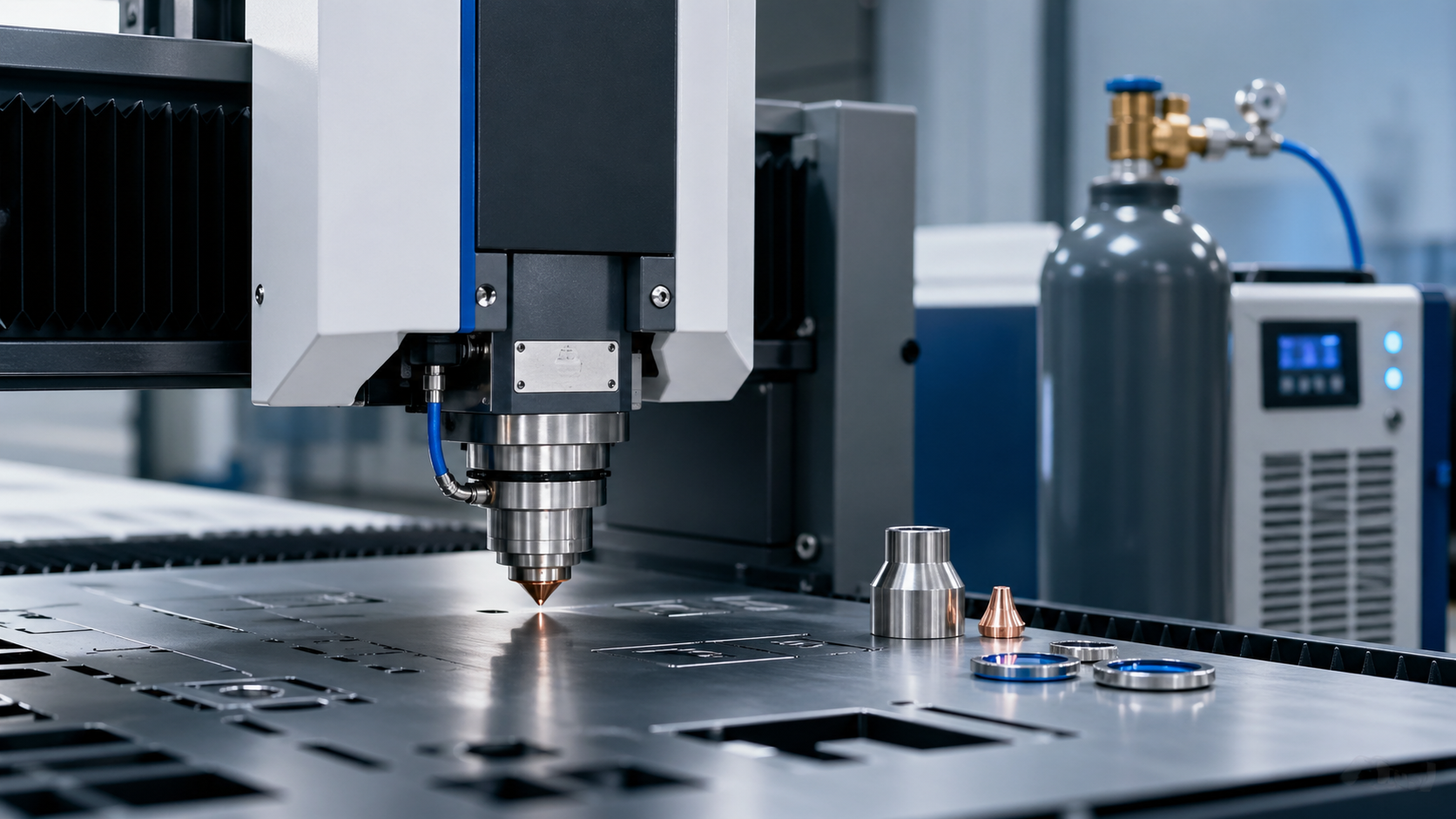
Fibre laser consumables include cutting nozzles, focusing lenses and protective windows for the cutting head. These wear out through normal use and need periodic replacement.
Nozzles are the most frequently replaced item. A nozzle might last anywhere from a few days to several weeks depending on cutting intensity, material type and operator technique. Crashes or collisions with material shorten nozzle life significantly, so good operator habits matter.
Focusing lenses and protective windows last longer but are more expensive to replace. Protective windows sit between the lens and the workpiece and take the brunt of spatter and debris. Keeping these clean extends the life of the lens behind them. A contaminated protective window left in service can damage the focusing lens, turning a low-cost replacement into a much more expensive one.
Consumable costs are modest relative to electricity and gas, but they add up over a year of production. Buying in reasonable quantities from your machinery supplier, rather than scrambling for individual replacements, keeps costs lower and avoids downtime from stock shortages.
Cooling System Costs
Every fibre laser requires a chiller to maintain stable operating temperatures for the laser source and cutting head. The chiller runs continuously during operation, consuming electricity and requiring periodic maintenance.
Chiller maintenance is straightforward: regular coolant checks, filter changes and cleaning of heat exchangers. Neglecting the chiller risks overheating the laser source, which can cause power degradation or unplanned downtime. The maintenance cost is low. The cost of ignoring it is not.
For a fuller explanation of how fibre laser machines generate and manage the cutting beam, including the role of cooling systems, see our guide on how fibre lasers work.
Routine Maintenance and Servicing
Fibre lasers have fewer maintenance demands than CO2 systems. There are no mirrors to align, no gas tubes to replace and no resonator to service. The solid-state design means fewer moving parts and longer intervals between major servicing.
Routine maintenance includes keeping the cutting bed clean, checking and replacing extraction filters, inspecting guide rails and drive components, and ensuring the cutting head optics stay in good condition. Most of this is operator-level work that takes minutes rather than hours.
Annual or biannual professional servicing is recommended, particularly for checking laser source output, calibrating the cutting head and inspecting the machine’s mechanical systems. AFM’s support and servicing team handles this for customers across the UK, which keeps the machine running at specification and avoids gradual performance drift that increases consumable waste and reduces cut quality.
How Running Costs Compare to CO2 and Plasma
Fibre lasers are significantly cheaper to run than CO2 laser systems. The electricity saving alone, roughly a factor of two to three, makes a noticeable difference over a year of production. Add in the reduced maintenance burden (no laser gas mixture, no mirror alignment, no tube replacements) and the total operating cost gap widens further.
Against plasma cutting, the picture depends on what you cut and how thick it is. Plasma handles very thick material cheaply but produces rougher edges and wider kerfs. For thin to mid-thickness sheet metal where precision and edge quality matter, a fibre laser’s running costs are competitive and the downstream saving on secondary finishing often tips the balance.
If you are weighing up these options and considering whether to bring laser cutting in-house, running costs are a central part of that calculation alongside capital outlay and production volume.
Building Your Own Running Cost Estimate
Rather than relying on generic hourly figures, use this framework to estimate costs for your own workshop:
| Cost category | What drives it | How to estimate |
|---|---|---|
| Electricity | Laser source wattage + ancillaries, hours of operation, UK commercial rate | Total machine draw (kWh) x electricity rate x hours per month |
| Assist gas (nitrogen) | Material type, thickness, cutting pressure, supply method | Monthly gas invoices or supplier quote based on expected volume |
| Assist gas (oxygen) | Mild steel volume, thickness | Lower cost per unit than nitrogen, lower volume per cut |
| Consumables | Nozzle, lens and protective window replacement frequency | Track replacement intervals over first 3 months, then annualise |
| Cooling | Chiller electricity draw, coolant and filter replacement | Included in total machine electricity draw, plus minor annual parts cost |
| Servicing | Annual or biannual professional service | Fixed cost from your machinery supplier |
Contact AFM for guidance on realistic figures for any of these categories based on your specific machine specification and workload. We would rather you had accurate numbers than optimistic ones.
What Affects Running Costs Most
Two factors have the biggest impact on total operating spend: assist gas strategy and machine utilisation.
Workshops that optimise their gas supply, whether by negotiating bulk rates, switching to on-site nitrogen generation for high-volume work, or choosing oxygen cutting where edge finish allows, can reduce their single largest variable cost by a significant margin.
Machine utilisation matters because fixed costs (electricity draw during idle, chiller operation, annual servicing) spread across more productive cutting hours. A machine sitting idle between manual sheet loads costs the same in ancillary power as one cutting parts. Dual-pallet systems, efficient nesting software and disciplined job scheduling all improve the cost-per-part figure without changing the running cost inputs themselves.
Are Fibre Lasers Cheap to Run?
Fibre laser running costs are lower than most workshop owners expect, particularly compared to CO2 systems or the cumulative cost of outsourcing cutting work. But they are not zero, and they vary meaningfully depending on how you use the machine.
The workshops that control running costs best are the ones that understand each cost category, track their actual spend, and make informed decisions about gas supply, consumable management and machine utilisation.
If you are evaluating a fibre laser and want to understand what running costs would look like for your specific operation, speak with AFM’s machinery team for guidance based on your materials, volumes and production setup. For a broader look at the technology itself, explore our fibre laser machinery range.
For independent industry resources on fabrication equipment standards and supplier guidance, the Manufacturing Technologies Association (MTA) is a useful reference point.