How to Select the Right Bending Rolls for Your Workshop
Choosing the right bending rolls means matching four things to your production: the maximum material thickness you need to roll, the rolling width, the tightest diameter you need to achieve, and whether you need pre-bending capability. Get these four factors right and the rest of the specification follows logically.
Most workshops overspecify on capacity and underspecify on pre-bending. The result is a machine that handles the material thickness but leaves long flat sections at each end of the rolled part, creating rework that proper specification would have avoided.
Material Thickness and Width Set the Baseline
Every set of bending rolls has a rated capacity expressed as maximum thickness at a given width for mild steel. A machine rated at 10mm x 2,000mm will roll 10mm mild steel across a 2,000mm width. Thicker or wider material exceeds the machine’s capability and risks damage.
Material type matters as much as thickness. Stainless steel and higher-strength alloys require significantly more force to roll than mild steel of the same thickness. If you regularly work with anything other than standard mild steel, specify the machine against the actual yield strength of your typical materials, not just the thickness figure.
Minimum Diameter Depends on Roll Size
The tightest cylinder you can form is directly related to the diameter of the top roll. A practical rule is that the minimum achievable inside diameter is roughly 1.5 times the top roll diameter. A machine with a 200mm top roll will struggle to produce anything tighter than about 300mm inside diameter.
If your work requires tight radii, you need a machine with a smaller top roll, which typically means lower thickness capacity. There is always a trade-off between tight rolling and heavy plate capability. Workshops handling both requirements sometimes keep two machines rather than trying to do everything with one.
3-Roll vs 4-Roll: Which Configuration?
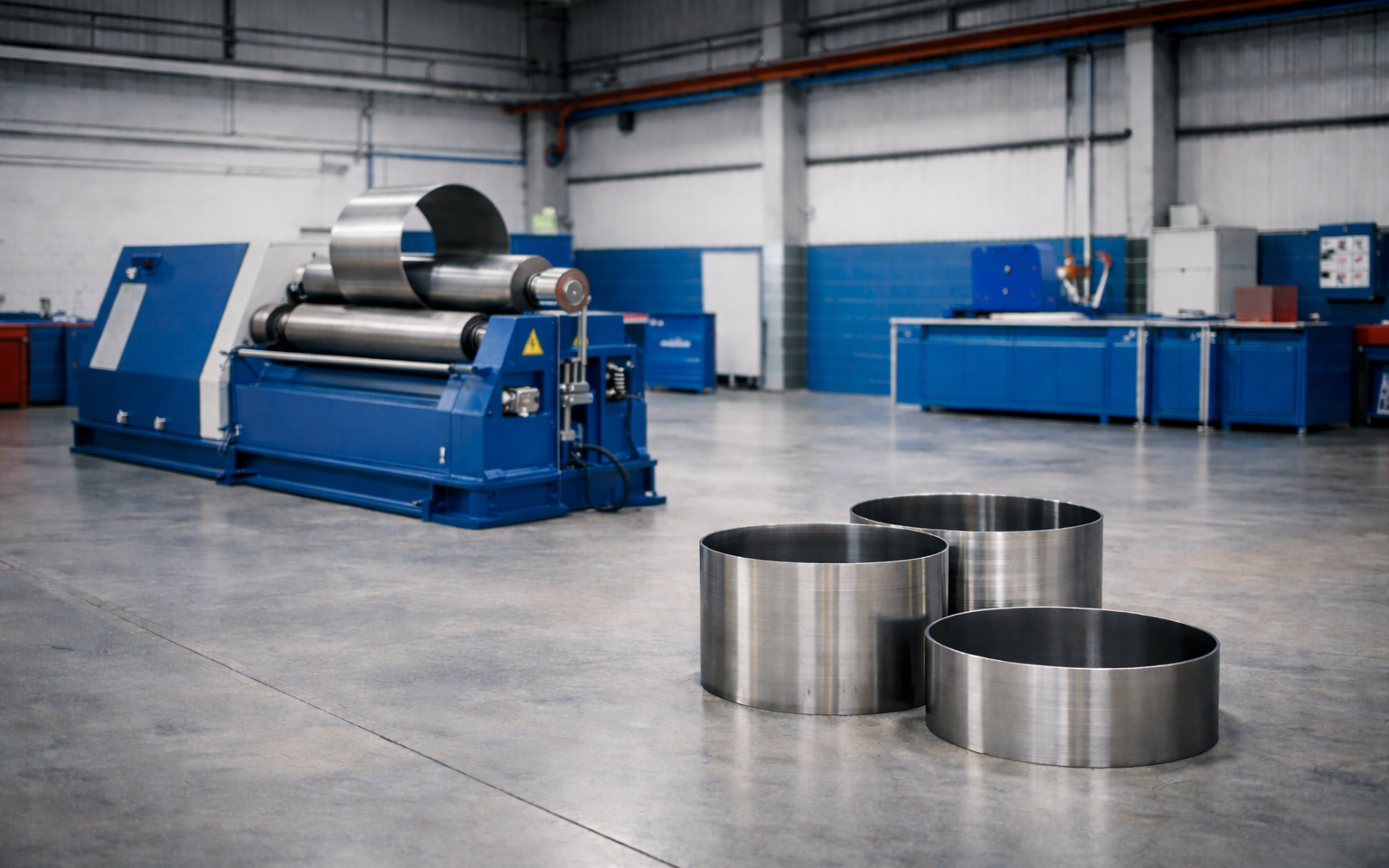
Three-roll initial-pinch machines are the most common in general fabrication workshops. The plate feeds between two rolls while a third bending roll applies pressure from below. These machines handle a wide range of work, are simpler to operate, and cost less than 4-roll equivalents.
Four-roll machines add a second bending roll, allowing pre-bending at both ends of the plate without removing and reinserting the workpiece. This makes 4-roll machines faster for production work and produces shorter flat sections at the plate edges. The trade-off is higher cost and slightly more complex operation.
For workshops rolling occasional cylinders or segments, a 3-roll machine usually provides the best balance of capability and cost. For production environments where cycle time and minimal flat sections matter, 4-roll machines earn their premium.
Pre-Bending Capability Reduces Rework
Pre-bending is the process of forming a curve at the leading and trailing edges of the plate before rolling the main body. Without pre-bending, the plate edges remain flat, leaving a straight section that either needs cutting off or secondary forming on a press brake.
Three-roll machines can pre-bend one end of the plate, then the operator removes and reinserts the plate to pre-bend the other end. Four-roll machines pre-bend both ends without removal. The difference in cycle time is modest for one-off work but significant across a production run.
If your finished parts need a consistent radius right to the edge, pre-bending capability is worth specifying from the start. Retrofitting it later is not practical.
Used Bending Rolls Offer Proven Value
Well-maintained bending rolls are mechanically straightforward machines with long service lives. Quality used bending rolls from reputable suppliers deliver the same rolling capability at significantly lower capital cost. AFM inspects and services used rolling equipment before sale, ensuring the rolls are true, the hydraulics are sound, and the machine performs to specification from day one.
Matching Rolls to Your Workshop
Start with your heaviest typical material and your tightest typical diameter. These two figures narrow the field quickly. Then decide whether 3-roll or 4-roll suits your production pattern, and whether pre-bending justifies the additional investment.
Browse AFM’s new bending rolls to compare specifications, or explore used bending rolls for proven machines at lower cost. For advice on which machine suits your specific materials and production, contact the team and AFM will help you specify the right rolls for your workshop.
For a deeper technical overview of rolling machine types and capabilities, The Fabricator provides a useful industry reference.