When to buy new or used fabrication machinery
Choosing between new or used fabrication machinery comes down to whether you need capability you do not currently have, or capacity you do. A new machine buys you current control technology, a warranty and a supplier who carries the conformity paperwork. A used machine buys you tonnage and bending length for less capital, with more of the checking left to you.
Most workshops we speak to have already half-decided before they call, usually on price. The better starting point is the work itself, because a machine that cannot hold your tolerances is poor value at any price, and a machine that exceeds them by a wide margin is capacity you paid for twice.
We have sold used fabrication machinery since 1975 and new machines for the last decade, so this comparison is drawn from both sides of the same business.
What separates new or used fabrication machinery
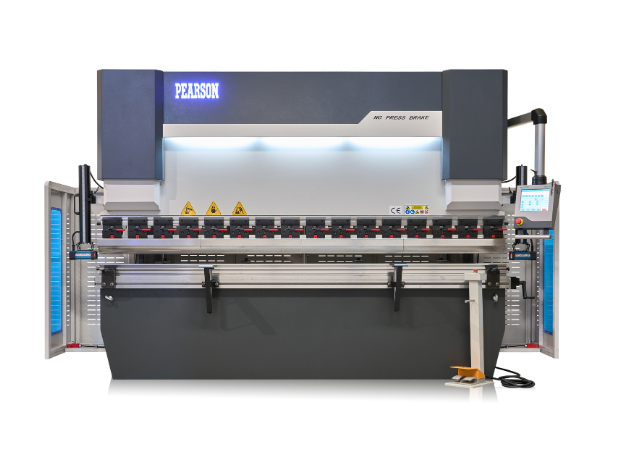
The specification gap between a good used machine and a new one is often smaller than buyers expect. A hydraulic press brake built fifteen years ago still bends to the same tonnage it did when it left the factory. The differences that matter sit around the machine.
| Factor | New machine | Used machine |
|---|---|---|
| Capital cost | Highest | Typically a fraction, varying by age, hours and condition |
| Lead time | Build slot plus delivery | Available now, if the specification you need is in stock |
| Control technology | Current generation, offline programming, current software support | Whatever generation it was built with, and support depends on the controller |
| Warranty | Manufacturer or dealer, and duration and exclusions vary | Varies by seller, and some carry none |
| Conformity paperwork | UKCA or CE marking, declaration of conformity, instructions in English | Supplier must supply it safe and as originally placed on the market |
| Condition evidence | The build itself | Service records, demonstration, inspection |
| Depreciation | Steepest in the early years, and that is the resale loss you carry | Already absorbed by the first owner, so the resale position is steadier |
| Configuration | Specified to your parts | Whatever was specified for somebody else |
| Parts and support | Current model and parts in production now, with a support horizon set by how long the manufacturer keeps it | Depends on the manufacturer and the machine’s age |
| Running and aftercare cost | Quoted with the machine, and worth pricing for the whole term | Quoted separately more often, and worth pricing for the whole term |
Read the table as two different risk profiles. On a new machine you are paying to remove uncertainty. On a used machine you are keeping the capital and accepting the job of establishing condition yourself.
One axis this comparison does not attempt to cost is energy consumption. Newer drive systems generally use less, the difference is real, and the figures published for it are usually the manufacturer’s own. Price it from your own tariff and running hours before treating it as a deciding factor.
Aftercare decides more than the purchase price
The cost of a fabrication machine is the purchase price plus what it costs to keep running for the years you own it, and the second figure is the one that separates a good buy from a bad one.
Ask the same questions on both sides. Who installs and commissions it, and is that included or quoted separately? What training comes with it, and for how many operators? Who attends a breakdown, how quickly, and are the parts held in the country? What does a service contract cost, and what does it cover?
Our support and servicing covers planned yearly servicing on all the machinery we supply, emergency call-outs and spare parts held at our Cramlington site. Installation, commissioning and operator training are agreed machine by machine, so ask us to confirm in writing what applies to the machine you are considering, whether new or used, and get it written into the quotation. The same applies to any supplier you are comparing us against.
Where a used machine is the better buy
You need capacity, and the work is within an older machine’s tolerance. A second brake taking overflow off the first does not need to be the best machine in the building. If the parts going through it are straightforward and will stay that way, a sound older machine does the job for years.
The specification you need is sitting in stock. Lead times on a new build can run months. If a job has landed and the capacity has to exist by the end of the quarter, availability beats specification. Our used press brakes are listed with tonnage, bending length and control, so you can check that against your drawings before anyone quotes.
You are proving out a process before committing. Buying used to test whether a new capability earns its place is a reasonable way to find out, and the resale position on a machine that has already depreciated is considerably better than on one that has not.
Capital is the constraint. The cash difference between new and used is frequently the difference between buying this year and waiting.
What you give up. Control support is the usual sticking point, and it is the one that catches people out. An older controller may have no current software support, no offline programming, and no route to replacement components. Condition is your job to establish, warranty terms vary by seller, and the operator who knows that generation of machine may be the one person you cannot replace.
Where a new machine is the better buy
The part decides it. If your tolerances, cycle times or repeatability depend on current control technology, no amount of good condition on an older machine closes that gap. Angle correction, crowning and current back gauge configurations do things their predecessors do not.
Nobody has it second-hand. Some configurations rarely appear on the used market in the length, tonnage or tooling arrangement you need. Waiting for one to surface has its own cost.
Downtime is expensive. A machine going into a single-shift cell where a stoppage halts the line justifies a warranty and current parts availability in a way an overflow machine does not.
You need the paperwork. New machinery placed on the market in Great Britain must be UKCA or CE marked, supplied with a declaration of conformity and carry instructions in English.
What you give up. The capital, the lead time, and the steepest part of the depreciation curve, which is a resale loss you carry instead of the first owner. New warranties vary in length and in what they exclude, so read the terms before treating one as cover. Parts in production today is no guarantee of parts in production in year eight, so ask how long the manufacturer supports a model after it is superseded. And operators who know your old control need time on a current CNC before the machine runs at the rate you costed.
How capital allowances treat new or used machinery
Full expensing gives companies 100% first-year relief, and HMRC’s guidance sets two conditions that decide this comparison: ‘only companies can claim’, and the machine must ‘be new and unused’. That looks decisive until you read the Annual Investment Allowance, which also gives 100% relief, on up to £1 million a year, and carries no new-and-unused condition. So for a workshop spending under £1 million on plant in a year, which is most workshops buying a single press brake or guillotine, a used machine and a new one arrive at the same relief. Confirm your own position with your accountant, and price the finance terms on both options before the cash difference decides anything.
Retrofitting a control onto the machine you already own
Both options above assume you are buying a machine. A third route suits a narrower set of workshops and rarely appears in the comparison.
If your existing machine is mechanically sound and the limitation is the control, a CNC retrofit puts current programming onto the frame you already have. It costs less than a replacement, keeps a machine your operators know, and sidesteps the lead time on a new build.
It fits where the frame has life in it and the tonnage still matches the work and it does not fit where the mechanical condition is the problem, and it is worth an honest assessment before anyone quotes for it. We fit retrofits and we will say when one is poor value.
Deciding between new or used fabrication machinery
Take the drawings for a straightforward repeat job and a demanding one, record the material grade, thickness, longest bend and tolerances, and add the volumes and how often the work changes.
Then apply one rule. If the parts you need to make sit inside what an older machine can hold, and will still sit inside it in five years, buy used and keep the capital. But if the parts depend on something only a current control can do, or a stoppage costs more than the price gap, buy new. If the frame you own is sound and the control is the limitation, retrofit. Where the first two both hold, and they often do, let the stoppage cost decide, because capacity you cannot rely on is not capacity.
Our new machines are quoted to specification instead of listed, so the shortest route on either side is a conversation about the parts. Send us the drawings and the workload and we will tell you which of the three fits, including when the answer is a new machine, when it is a used one, and when it is nothing at all this year. Talk to AFM Europe about your requirements and we will work through the specification with you before anyone quotes.